
He was an abandoned beer bottle. She was a lone glove. They said their love would never last.
They were wrong.
Sunday mornings in Oxford: coming soon to a theater near you.
He was an abandoned beer bottle. She was a lone glove. They said their love would never last.
They were wrong.
Sunday mornings in Oxford: coming soon to a theater near you.
This last category is the one I'm writing about today.
I'm also a believer in being a bit irreverent. If you can't laugh at yourself, what's the point?
So, in the spirit of irreverence, I give you Feminist Theory Bingo, compiled from the readings, lectures, and discussions during this term's Fem Theory course.
Print these out and bring them to your next Fem Theory lecture.


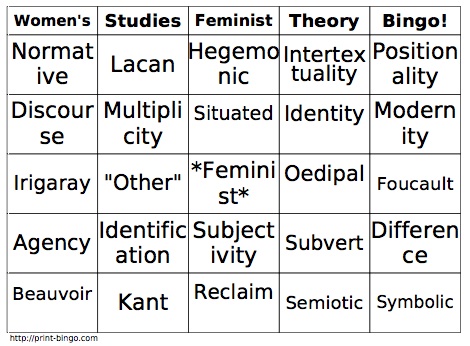

As always, I've tried to put direct quotes in quotation marks, but since this is a typed transcript of my handwritten notes, I might not have been as effective as I'd like. However, this time I have included page numbers!
IGF – independent gay forum. Wants: full LGBT inclusion; equality under the law; they deny the conservative claims that gay s pose a threat to morality or order; they oppose progressive claims that gays should support radical social change.
This idea of a “third way” rhetoric that’s somewhere between conservative and progressive keeps coming up as part of neoliberalism.
Neoliberalism is pro-corporate, and anti big government.
Its cultural politics are often discussed separately from its economic. (She’s implying that you can’t really separate them). But, its antidemocratic, antiegalitarian agenda has shaped the discussion.
Neoliberalism has often been presented as being non political – more into economic stuff. Very into privatization. However, Duggan points out that their rhetorical universe doesn’t match their reality. For instance, they think it’s good when the state supports private business interests, but not when it supports the public interest. She believes that they’re very conflicted in the arenas of cultural and personal life.
The new neoliberal sexual politics of the IGF can be called a new homonormativity, that upholds heteronormative institutions and promises a privatized, depoliticized gay culture.
She sees as consistent the gay movement goals of: right to sexual privacy, expansion of gay public life.
In the 1950s and 1960s (postwar) – conservatives saw the state as intrusive, while progressives thought it should guarantee equality of access. Conservatives thought that only the “favored form of family life” should get privacy, while progressives wanted a right to sexual and domestic privacy for all.
In the 1970s, gay politics interacted with feminist and antiracist rhetoric and strategies. There was an emphasis shift away from privacy toward visibility. They wanted a right to privacy in public, and the right to publicize private matters.
1990s – a new gay moralism attacked promiscuity and the “gay lifestyle” – advocated monogamous marriage as responsible and disease preventing.
Dramatically shrunken public sphere, narrow zone of “responsible” domestic privacy. Bawer – invokes “most gay people” as conventional and anti left. He wants a trickle-down of gay-positive sentiments from the elite boardroom to factories.
(184)
Attacks the “’extremes’ of what he calls prohibitionism and liberationism.” Again with the “third way” approach.
He sees prohibitionism as that which “would morally condemn and legally punish homosexuality.” Heterosexuality is the norm, and is essential to society.
Sullivan rejects this as inconsistent (non-reproducing hetero couples would also “have to be condemned”) and wrong.
(185)
He sees homosexuality as “an involuntary condition,” and because of this, that there’s no point in “attacking it morally and legally.”
He’s against liberationism for the same reason – they say that “sexual identities are socially constructed” but he says they’ve always existed. But, apparently his “description of what he calls liberationism is… more cartoonishly reductive than his description of prohibitionism.”
He describes “queer” as “a uniform and compulsory identity” when the whole point of “queer” is the opposite.
(186)
Sullivan “defines liberalism as the commitment to a formally neutral state and to the foundational freedoms of action, speech, and choice”.
He claims that the agendas of the civil rights movement are “the wrong road in contemporary liberal politics,” and says that things like affirmative action and other antidiscrimination laws are “veering too far away from the proper goals of state neutrality.”
(187)
He endorses “conservative goods” except the idea of “private tolerance coupled with public disapproval of homosexuality.”
Sullivan’s plan is to legalize gay marriage and military service, “then demobiliz[e] the gay population to a ‘prepolitical’ condition.”
Duggan thinks that Sullivan’s support of gay marriage as “social and public recognition of a private commitment” is too close to what he warned against before with the ideas of civil rights movements, as he feared that the law would be “forced into being a mixture of moral education, psychotherapy and absolution.”
(188)
Sullivan worries that domestic partnership could open a whole barrel of legal worms, since frat brothers or an old person and live-in nurse could qualify. Also believes that it “chips away at the prestige of traditional relationships and undermines the priority we give them.”
Duggan thinks that domestic partnership is actually more like his idea of “state neutrality about ‘values’” than the “hierarchy and subjective judgment” of traditional marriage. Believes that he sees “the most conventional and idealized form of marriage as lifetime monogamy… in utterly prefeminist terms”.
His view is in line with the rest of the neoliberal movement in that he wants “to construct a new public/private distinction” that involves “very few policy decisions”.
“Marriage is a strategy for privatizing gay politics”. He also believes that marriage and the desire to serve in the military are not actually political: “The family is prior to the state; the military is coincident with it.”
(189)
David Boaz, VP of libertarian Cato Institute: domestic partnership “undermines marriage’s premium on commitment.” But he also believes that “welfare programs offer resources especially to poor women, who are thus enabled to make undesirable choices.”
(190)
“The privacy-in-public claims and publicizing strategies of ‘the gay movement’ are rejected in favor of public recognition of a domesticated, depoliticized privacy.”
A look I've been really drawn to recently is the idea of dark, winter florals (for examples, see Domestic Sluttery and Vogue). Florals have always seemed very English to me; before moving here, my idea of the quintessential English cool-girl outfit involved a floral dress over black tights with cool rock-and-roll booties, and perhaps a denim jacket or slouchy cardigan and "infinity scarf" (which the Brits call a "snood" - so much more fun).
However, straight-up floral just isn't me. I need something a little darker and edgier, with just a hint of punk or goth. So when I started noticing these floral blouses with black trim all over the place, I was excited. The combination of floral and buttoned-up was a look I loved, and the black trim kept it from being too girly.
As I always do, I shopped around. Here are the results, at various price points.


So, as I tend to do in this case, I headed to Primark, as I'd noticed a GORGEOUS dark floral shirt there on an earlier trip, and even though £12 was a little more than I'd like to spend, I figured it was pretty enough to be worth the splurge.
HOWEVER.
When I got there, I found that this lovely:

had been reduced to £5. Yes, you read that right. I wore it yesterday and got so many compliments on it. I'm thinking of replacing the garish gold buttons with more subtle black ones, but really. You can't beat that.
Moral of the story: know what you want, and shop around!

Ferris wheel at the Oxford Christmas Light Night street fair.

The Radcliffe Humanities building; home to the philosophy library and the closest printers to my dorm.

Christmas decorations over Cornmarket Street: Tom Tower in the distance.
