When the sun decides to come out, this is a really beautiful town.
When the sun decides to come out, this is a really beautiful town.

Taken at midnight while waiting for the bus back to Oxford.

Obviously the first instinct was to email mom, because at 3,000 miles and 5 time zones away, she could TOTALLY do something about it.
Anyway.
I took to the Google, as you do, and got kind of terrified at the slew of articles about moths eating peoples wardrobes, carpets, furniture, and sheep. In googling, I learned some facts about moths.
Things moths like:
*Dark (well, these kinds of moths anyway)
*Natural fibers
*Your sweat and skin cells on natural fibers (ew!)
Things moths do not like:
*Being disturbed (join the club)
*Lavender
*Cedar (but that's debatable)
Some of the recommended ways of dealing with moths are dry cleaning all your stuff (way too expensive), calling an exterminator (expensive - plus chemicals), or putting all your stuff in a freezer for a bit (not in a dorm!). On top of all of that, my best friend emailed me to let me know that it's bad luck to kill a moth in the house. However, upon Googling further investigation, I discovered that
*A black moth in the house means the spirit of a deceased loved one is visiting,
*and a white moth in the house means death. Yeah.
Death for the moth, maybe.
Step one was to rush to Amazon and purchase some cedar things to put on my hangars, cedar balls to put in my drawers and in the pockets of cardigans in the closet, and two different kinds of moth traps.
This one contains female moth pheromones that lure the male moths in, thinking they're going to get some moth-loving, only to catch them on a sticky strip of despair. Then things get a little freaky, as the the female pheromones get all over the stuck male moths, causing other male moths to think that the stuck male moths are females... well, you see where I'm going with this.
This trap... well, I'm not sure HOW it works, but it says "MOTH KILLER" in big letters on the front, so it probably works, right?
I went to bed feeling a little prepared and more than a little creeped out.
This morning, I woke up with a mission: to take the first steps to eradicating these pests on my own. I started by taking everything out of my closet. In batches of four or five, I
*took the item off its hanger,
*gave it a good shake out the window (One of the sites said to shake your clothes out in the sunlight, as the UV rays will cause the larvae to be uncomfortable and perhaps let go of your clothing. I was skeptical but desperate. It was cloudy out, but I work with what I'm given.),
*and hang it on my drying rack, which was placed by the window.

While the clothes were airing on the rack, I laid out my hangers on the bed. They're the super-narrow, kind of fuzzy ones, so I hoped that would help this step work better than it might on plastic hangers.
Now, if you are an insomniac, like I am, chances are someone has given you something lavender-scented at some point in time. It's supposed to help us sleep. It never does. HOWEVER, I have never been as grateful for my little spray bottle of Essence of Vali Soothing Mist as I was today. While the clothes were airing, I spritzed the hangers with the lavender spray, gave each item of clothing another good shake out the window, and put it back on the hanger and in the closet.
Tomorrow I will walk up to my college to pick some of the lavender that grows there, and make little sachets or something to put in my drawers and closet. Then I will wait with bated breath for my moth-killing apparati to arrive.
SO. Today I took the preliminary steps in de-mothing my wardrobe (details to come).
Then, work-wise, I:
Typed up my notes on "'The Closet Opened': A Reconstruction of 'Private' Space in the Writings of Margaret Cavendish," did a really rudimentary summary of that article, then did a summary of ""Making a Spectacle": Margaret Cavendish and The Staging of the Self."
They're not really summaries as much as they are a list of main ideas, a brief outline of the structure of the essay, a list of other authors they reference, their thesis, their conclusion, and who the author is. Oh, and which of Cavendish's works they reference so I can narrow down which ones seem the most important. That sounds like more work than it was. I'd wanted to get more done, but we all know how that goes.
Tomorrow my goal is to set my alarm and then actually get up and start doing shit when it goes off. Wish me luck.
I am 300% more likely to bring my own bag to the grocery store now that I have a £3 Guns n Roses tote bag from Primark.

Whatever it takes, I guess!

I remember very little about "The Rime of the Ancient Mariner". Here's what I do remember:
1. There was an albatross.
2. There was a ghost ship.
3. You can sing The Rime of the Ancient Mariner to the tune of the Gilligan's Island theme song.
Wollstonecraft and Fell both saw religion as a highly personal experience, and drew much of their claims for women’s rights from their experience of religion as highly personal. They also both emphasize the importance of experiencing religion as a personal relationship with God, unmediated by the church or the clergy. By doing so, both women were able to maintain the pious reputations that were necessary to social propriety, while also satisfying the possible disconnects between their desire for faith and the teachings and attitudes of the systems of faith that surrounded them.
Both Wollstonecraft’s and Fell’s desires for a personal relationship with God echo the desires of other writers we’ve read for close, personal female relationships. As in the writings concerning female education and utopias, Wollstonecraft and Fell not only experience their relationships with God as happening in a realm that is removed from the mediating world of men, but also recognize and then deliberately and actively remove the male mediation from this relationship by distinguishing “between human custom and God’s will for humanity” (Thickstun 275). Fell keeps her rationale for this distinction firmly located in the Bible; for instance, she cites the passage concerning the creation of mankind and comments “Here God joyns them together in his own Image, and makes no such Distinctions and Differences as Men do” (Fell). This distinction between God’s rules and man’s rules is central to her argument that women should be allowed to preach. By the time Wollstonecraft was writing, it appears that this idea of an unmediated relationship with god as the preferred form of female religion had become more common. Taylor cites a female preacher of the time who left her husband for her church, saying “I chose to obey God rather than man;” this reason for separation might have been calculated to justify such an unusual act, but the idea may have been appealing to other women of the time. Perhaps these personal relationships allowed each woman to view God a little differently; for instance, according to Wollstonecraft, we love god because he deserves it, not because he commands it. So if virtue, not power, deserves respect in heaven, it follows that it should deserve the same respect here on earth. Wollstonecraft uses that idea to describe how women should love their husbands; while she does not explicitly state that that idea makes it obvious that women deserve the same respect, it is not a drastic stretch to infer it.
Wollstonecraft and Fell each used this personal relationship with God to further their larger claims: Fell, that women should be allowed to preach, and Wollstonecraft, that they be allowed larger rights within society. By citing specific examples from the Bible, they may have hoped to give their arguments weight in the eyes of their readers, as arguing with the Bible would have been more difficult than arguing with a woman.
Fell, for one, “claims for herself an unmediated access to Scripture and to divine truth” (Thickstun 275). For instance, she does this by declaring that she will “lay down how God himself hath manifested his Will and Mind concerning Women, and unto women.” Of course, by saying this, she claiming knowledge of scripture in a way that is potentially as problematic as the way in which the male translators and recorders of the Bible did, but the point is, of course, that she is claiming her right to make such an interpretation. This idea of claiming the right to speak echoes Griffin’s view that Wollstonecraft addresses “questions of political and discursive authority linked to a patriarchal social order” (296). While questioning patriarchal issues of hierarchy is central to feminist thought, the fact that Wollstonecraft was so clear, logical, and persuasive makes her arguments seem fresh and innovative (as they were at the time).
One major divide between the two works occurs in the authors’ relative relationships to the idea of formal education. Fell seems to view formal education as a masculine domain that has the potential to distort the word of God. According to the Stanford Encyclopedia of Philosophy, “Fell maintains that most university-educated interpreters of scripture invariably lead others away from God to their own inventions and imaginations.” In line with Quaker beliefs of her period, she believed that inner light, not human teaching, was the only true “spiritual guide” necessary (Stanford).
However, if we look at their respective uses of the word “reason,” it becomes clear that they were arguing similar things, even though they were going about it in slightly different ways. Considering Wollstonecraft’s “alternative rhetoric and system of reasoning” (Griffin 306), it looks as if Fell followed a similar line of thinking, even if she did not connect it to the idea of formal education as Wollstonecraft did. Fell presents her own alternative system of reasoning through her careful and thorough reinterpretations of Biblical passages, asserting, like Wollstonecraft, “that man’s reasoning was fundamentally flawed and inaccurate” (Griffin 296). However, Wollstonecraft tied her ideas of religious advancement to ideas of formal education. This makes sense, as at the time “Women conduct-book writers… tended to emphasize women’s intellectual relationship to God, urging close study of the Bible and familiarity with major theological works” (Taylor). This idea seems to echo Mary Astell’s idea that one must truly understand religion, on an intellectual level, in order to truly believe it. Even the protagonist of Wollstonecraft’s fictional novel believed that it was “right to examine the evidence on which her faith was built.” However, this intellectual investigation seems to go against Fell’s ideas of religion as result of divine inspiration.
One concept I’m trying to work out is the relationship of religion to action in each of the writings. As Taylor points out, Wollstonecraft saw religion as a “principle of conduct”; I wonder if this idea of religion as a way of acting could be connected to ideas of subject formation that we’ve discussed in our theory class. This would especially make sense in light of Griffin’s point that “Patriarchy calls women into being as objects of male pleasure and creation” (306); by using the ideals of a patriarchal religion as a way of affirming subjectivity, Wollstonecraft could have been resisting the objectifying forces of the hierarchies reinforced by the church. I’m trying to figure out how that view of religion interacts with Fell’s, as Fell saw religion as more important than social propriety (Thickstun 272). The idea of religion as a way to behave properly seems to conflict with the idea of religion as more important than behaving properly (although I’m aware that Wollstonecraft’s idea of proper was more personal and Fell’s was more publicly-based, I do assume that they have some things in common; Fell’s version of propriety, as a Quaker, was probably more based in her faith to begin with, while Wollstonecraft was critiquing the behavior of the aristocracy). However, I wonder if it might be useful to see the historical distance between the two as mediating those ideas of proper behavior. Perhaps both used their understanding of social, public behavior and personal, private religion in similar ways when it came to addressing norms of behavior. If in Fell’s Quaker community it was seen as proper for women to avoid speaking (especially in religious contexts), then her idea of religion as more important than propriety is in opposition to the social norms. Wollstonecraft’s perspective seems a little less clear-cut; however, judging from her writing it seems that socially acceptable behavior for women (at least the women she was criticizing) was less focused on being proper and more intent on being charming. So it’s possible that each woman interpreted the relationship between religion and behavior in a way that opposed the behavioral norms for women at her time.
One theme that seems similar to both works is the idea of women’s spiritual qualities as superior to men’s; both writers also seem very aware of how this privileging of women’s spiritual qualities is used to justify their lack of social, economical, or political power. For instance, Thickstun discusses how women’s speech was considered more inspired or authentic than men’s (273). It seems as if this idea of authenticity is similar to the idea of women as closer to nature in the nature / civilization category within ideas of a masculine / feminine binary. It is interesting to note, however, that in this binary, the body is considered feminine and the mind masculine, but there is no gendered conception of the soul. Wollstonecraft and Fell both address this idea, using it as support for the idea that men and women are equal in the eyes of God. Indeed, according to Wollstonecraft, it is “not philosophical to speak of sex when the soul is mentioned,” and Fell reiterates, in relation to the Creation story, that “God the Father made no such difference in the first Creation, nor ever since between the Male and the Female.” However, both women were still tied to a world where they, by virtue of their bodies, were seen on that hierarchy. On a similar note, Fell also seems to believe that women’s authority is “derived from a personal experience of the Spirit rather than of the body”. I seem to be encountering in a lot of my readings recently this idea that men know things through the bodily senses, while women rely more on intuition; this idea from Fell seems to continue that theme. I’d guess that while this idea of intuition could be privileged in some situations, it also might be devalued since it relies less on hard evidence in making claims and decisions.
Wollstonecraft also encountered the idea that women’s place in religion was guided by some kind of inherent spirituality that they possessed. A woman’s emotional relationship to religion was seen as “intrinsically more powerful than that of men, a view reinforced by the idealization of pity as the primary Christian sentiment” (Taylor). This idea within Christianity of women’s more natural empathy positioned them as superior to men in matters of the spirit; however, this can appear as almost a consolation prize for the social limits they faced. For protestant women of Wollstonecraft’s time, being a proper Christian woman held many contradictions, as women were exalted for spirituality but held down socially (Taylor).
Griffin’s discussion of Wollstonecraft’s discourse discusses her in the context of Marxism: there is some evidence that Fell might have shared some of Wollstonecraft’s views about women as property. For instance, Thickstun mentions that Fell “exposes priestly hypocrisy about women’s speaking by accusing them of making ‘a trade’ of women’s words” (278). This idea of “trade” clearly relates to the Marxist feminist idea that “Women comprise not only propertyless but self-less individuals who exist as property” (Griffin 304). Wollstonecraft’s arguments “that alienation is a discursive problem encouraged by the interpellation of women as passive objects rather than as acting subjects” (Griffin 294) appear in Fell’s work as well. While I’m not as familiar with Marxist theory as I probably should be, the fact that these women were proposing Marxist ideas before Marx has to be significant. They obviously both recognized that women were used as commodities who did not possess their own subjectivity or agency, but simply existed as objects or “toys” to be used by men for their pleasure.

My shadow at noon. The low angle of the sun makes it feel like a perpetual late afternoon.

He was an abandoned beer bottle. She was a lone glove. They said their love would never last.
They were wrong.
Sunday mornings in Oxford: coming soon to a theater near you.
This last category is the one I'm writing about today.
I'm also a believer in being a bit irreverent. If you can't laugh at yourself, what's the point?
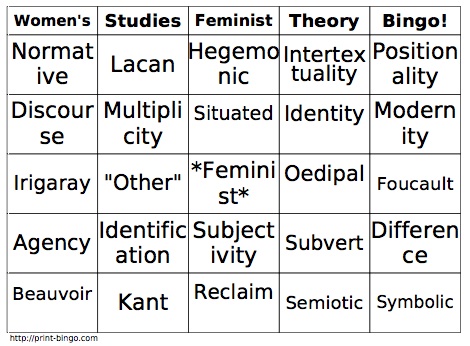
So, in the spirit of irreverence, I give you Feminist Theory Bingo, compiled from the readings, lectures, and discussions during this term's Fem Theory course.
Print these out and bring them to your next Fem Theory lecture.



As always, I've tried to put direct quotes in quotation marks, but since this is a typed transcript of my handwritten notes, I might not have been as effective as I'd like. However, this time I have included page numbers!
IGF – independent gay forum. Wants: full LGBT inclusion; equality under the law; they deny the conservative claims that gay s pose a threat to morality or order; they oppose progressive claims that gays should support radical social change.
This idea of a “third way” rhetoric that’s somewhere between conservative and progressive keeps coming up as part of neoliberalism.
Neoliberalism is pro-corporate, and anti big government.
Its cultural politics are often discussed separately from its economic. (She’s implying that you can’t really separate them). But, its antidemocratic, antiegalitarian agenda has shaped the discussion.
Neoliberalism has often been presented as being non political – more into economic stuff. Very into privatization. However, Duggan points out that their rhetorical universe doesn’t match their reality. For instance, they think it’s good when the state supports private business interests, but not when it supports the public interest. She believes that they’re very conflicted in the arenas of cultural and personal life.
The new neoliberal sexual politics of the IGF can be called a new homonormativity, that upholds heteronormative institutions and promises a privatized, depoliticized gay culture.
She sees as consistent the gay movement goals of: right to sexual privacy, expansion of gay public life.
In the 1950s and 1960s (postwar) – conservatives saw the state as intrusive, while progressives thought it should guarantee equality of access. Conservatives thought that only the “favored form of family life” should get privacy, while progressives wanted a right to sexual and domestic privacy for all.
In the 1970s, gay politics interacted with feminist and antiracist rhetoric and strategies. There was an emphasis shift away from privacy toward visibility. They wanted a right to privacy in public, and the right to publicize private matters.
1990s – a new gay moralism attacked promiscuity and the “gay lifestyle” – advocated monogamous marriage as responsible and disease preventing.
Dramatically shrunken public sphere, narrow zone of “responsible” domestic privacy. Bawer – invokes “most gay people” as conventional and anti left. He wants a trickle-down of gay-positive sentiments from the elite boardroom to factories.
(184)
Attacks the “’extremes’ of what he calls prohibitionism and liberationism.” Again with the “third way” approach.
He sees prohibitionism as that which “would morally condemn and legally punish homosexuality.” Heterosexuality is the norm, and is essential to society.
Sullivan rejects this as inconsistent (non-reproducing hetero couples would also “have to be condemned”) and wrong.
(185)
He sees homosexuality as “an involuntary condition,” and because of this, that there’s no point in “attacking it morally and legally.”
He’s against liberationism for the same reason – they say that “sexual identities are socially constructed” but he says they’ve always existed. But, apparently his “description of what he calls liberationism is… more cartoonishly reductive than his description of prohibitionism.”
He describes “queer” as “a uniform and compulsory identity” when the whole point of “queer” is the opposite.
(186)
Sullivan “defines liberalism as the commitment to a formally neutral state and to the foundational freedoms of action, speech, and choice”.
He claims that the agendas of the civil rights movement are “the wrong road in contemporary liberal politics,” and says that things like affirmative action and other antidiscrimination laws are “veering too far away from the proper goals of state neutrality.”
(187)
He endorses “conservative goods” except the idea of “private tolerance coupled with public disapproval of homosexuality.”
Sullivan’s plan is to legalize gay marriage and military service, “then demobiliz[e] the gay population to a ‘prepolitical’ condition.”
Duggan thinks that Sullivan’s support of gay marriage as “social and public recognition of a private commitment” is too close to what he warned against before with the ideas of civil rights movements, as he feared that the law would be “forced into being a mixture of moral education, psychotherapy and absolution.”
(188)
Sullivan worries that domestic partnership could open a whole barrel of legal worms, since frat brothers or an old person and live-in nurse could qualify. Also believes that it “chips away at the prestige of traditional relationships and undermines the priority we give them.”
Duggan thinks that domestic partnership is actually more like his idea of “state neutrality about ‘values’” than the “hierarchy and subjective judgment” of traditional marriage. Believes that he sees “the most conventional and idealized form of marriage as lifetime monogamy… in utterly prefeminist terms”.
His view is in line with the rest of the neoliberal movement in that he wants “to construct a new public/private distinction” that involves “very few policy decisions”.
“Marriage is a strategy for privatizing gay politics”. He also believes that marriage and the desire to serve in the military are not actually political: “The family is prior to the state; the military is coincident with it.”
(189)
David Boaz, VP of libertarian Cato Institute: domestic partnership “undermines marriage’s premium on commitment.” But he also believes that “welfare programs offer resources especially to poor women, who are thus enabled to make undesirable choices.”
(190)
“The privacy-in-public claims and publicizing strategies of ‘the gay movement’ are rejected in favor of public recognition of a domesticated, depoliticized privacy.”
A look I've been really drawn to recently is the idea of dark, winter florals (for examples, see Domestic Sluttery and Vogue). Florals have always seemed very English to me; before moving here, my idea of the quintessential English cool-girl outfit involved a floral dress over black tights with cool rock-and-roll booties, and perhaps a denim jacket or slouchy cardigan and "infinity scarf" (which the Brits call a "snood" - so much more fun).
However, straight-up floral just isn't me. I need something a little darker and edgier, with just a hint of punk or goth. So when I started noticing these floral blouses with black trim all over the place, I was excited. The combination of floral and buttoned-up was a look I loved, and the black trim kept it from being too girly.
As I always do, I shopped around. Here are the results, at various price points.


So, as I tend to do in this case, I headed to Primark, as I'd noticed a GORGEOUS dark floral shirt there on an earlier trip, and even though £12 was a little more than I'd like to spend, I figured it was pretty enough to be worth the splurge.
HOWEVER.
When I got there, I found that this lovely:

had been reduced to £5. Yes, you read that right. I wore it yesterday and got so many compliments on it. I'm thinking of replacing the garish gold buttons with more subtle black ones, but really. You can't beat that.
Moral of the story: know what you want, and shop around!

Ferris wheel at the Oxford Christmas Light Night street fair.

The Radcliffe Humanities building; home to the philosophy library and the closest printers to my dorm.

Christmas decorations over Cornmarket Street: Tom Tower in the distance.